
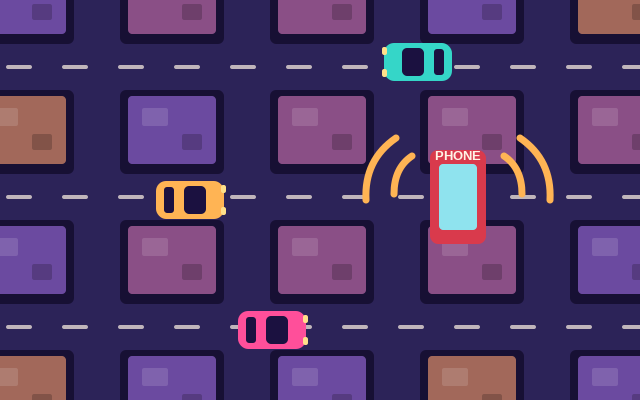
Original artwork, not a game screenshot.
Grand Theft Auto
Where the series began: a top-down crime game with an open city, ringing phone boxes and the police on your tail. It also includes the two London expansions.
- First release
- 28 November 1997 (PC, Europe)
- Developer
- DMA Design, Dundee, Scotland
- Publisher
- BMG Interactive in Europe; others elsewhere
- View
- Top-down
- Cities
- Liberty City, San Andreas, Vice City
- Sales
- 6 million by March 2001
How it was made
Development began on 4 April 1995 under the name Race'n'Chase. The idea started with players as the police chasing criminals. The team found that dull, so the player became the criminal.
The project had a difficult life. It took far longer than its early milestones planned, and there were several attempts to stop it.
Producer David Jones named Pac-Man as an influence: you run over people and get chased. Creative director Gary Penn pointed to the space game Elite, with its open structure and jobs you choose to take on.
| Role | People |
|---|---|
| Director and programmer | Keith R. Hamilton |
| Producer | David Jones |
| Design | Stephen Banks, Paul Farley, Billy Thomson |
| Music | Colin Anderson, Craig Conner, Grant Middleton |
How it plays
There are six levels, two in each of three cities, played in order. To finish a level you reach a points target, starting at $1,000,000 and rising later, and then reach the goal.
- Answer a ringing phone box to take a job for the local crime syndicate. Jobs can be done in any order.
- Finishing jobs raises your score multiplier. Failing one gives no points and can lock off other work.
- You can also earn points by causing chaos, completing challenges, or stealing and selling cars.
- Dying costs a life and your equipment. Lose every life and you restart the level.
- Crimes raise police attention. Arrest takes your equipment and halves your multiplier.
- The PC version supported multiplayer over a local network.
The three cities
| City | Based on |
|---|---|
| Liberty City | New York |
| San Andreas | San Francisco |
| Vice City | Miami |
All three names came back later as the settings of much larger 3D games.
Characters
You pick one of eight characters on PC (four on PlayStation) and give them a name. The choice only changes appearance.
- Robert “Bubby” Seragliano: head of the Vercotti crime family in Liberty City.
- Uncle Fu: elderly leader of a Chinese gang in San Andreas.
- El Burro: leader of a rival Latino gang in San Andreas.
- Samuel Deever: a corrupt Vice City police officer.
- Brother Marcus: a gang leader and Vice City's biggest drug dealer.
Story
Show story details (spoilers)
The plot is thin and is told mostly through jobs. In Liberty City you work for Bubby and kill his rival, Sonetti, before the police close in and you have to leave town.
In San Andreas you work for Uncle Fu and then for El Burro, who sends you to Vice City. There Deever blackmails you into working for him. You end up working for Brother Marcus, who gives you a large payout. You take your retirement money and the game ends.
Music and radio
Getting into a car turns on the radio. There are seven stations and a police radio band, and different vehicles receive different stations. Three DMA staff composed the radio music, recording at night in the office.
On PC you could swap in your own music CD once the game had loaded.
Controversy
The violence caused arguments, including talk of a ban, before the game was even out. Publicist Max Clifford's campaign used the outrage as free publicity. Brazil's Justice Ministry banned the game.
The Game Boy Color version removed most of the blood and swearing.
Versions and release dates
| Version | Date |
|---|---|
| PC, Europe | 28 November 1997 |
| PlayStation, Europe | 12 December 1997 |
| PC, North America | 24 March 1998 |
| PlayStation, North America | 30 June 1998 |
| Game Boy Color, Europe | 22 October 1999 |
Sega Saturn and Nintendo 64 versions were planned but never released. A PalmPilot version was announced in 2001 and later cancelled.
Some other websites give different dates. These follow Wikipedia.
London 1969 and London 1961
London 1969, an expansion pack developed by Rockstar Canada, came out for PC and PlayStation on 30 April 1999. It moved the action to a version of 1960s London, with period cars and British slang: “Busted” became “Nicked”. Writer and art critic John Berger voiced the Crisp Twins in a cutscene.
London 1961 was a shorter, free PC download released on 1 July 1999. It uses the same map and characters, eight years earlier.
London 1969 won a 1999 BAFTA Interactive Entertainment Award for sound. GameRankings averages were 75% on PC and 69% on PlayStation.
Reviews and sales
Reviews were mixed. Critics often liked the freedom, sound and sense of fun, and criticised the graphics and controls. GameRankings averages were 79% on PC, 68% on PlayStation and 57% on Game Boy Color.
| Date | Copies |
|---|---|
| November 1998 | Over 1 million shipped |
| October 1999 | 3.5 million sold |
| March 2001 | 6 million sold |
It stayed in the UK top 20 for at least 76 weeks.
Did you know?
- The UK cover is a photograph of a New York police car, with Trump Tower behind it.
- The main theme is credited to a made-up band, Da Shootaz.
- Radio station and song names mostly go unmentioned in the game; Head Radio is the exception.
Price and playing it today
The US PlayStation price was about $50 according to one secondary source. At the June 1998 exchange rate, that is about ₹2,118. This is a conversion, not an Indian shop price. We found no record of an official Indian release.
We did not find it on sale in a current digital store. Rockstar's old free download is no longer offered. Be careful with sites offering “free” copies.
Sources
Written in our own words. Last checked 29 November 2026. Many facts come from Wikipedia, which can be wrong. Prices and recent figures can change.
Think you remember it all?
Try the veteran quiz